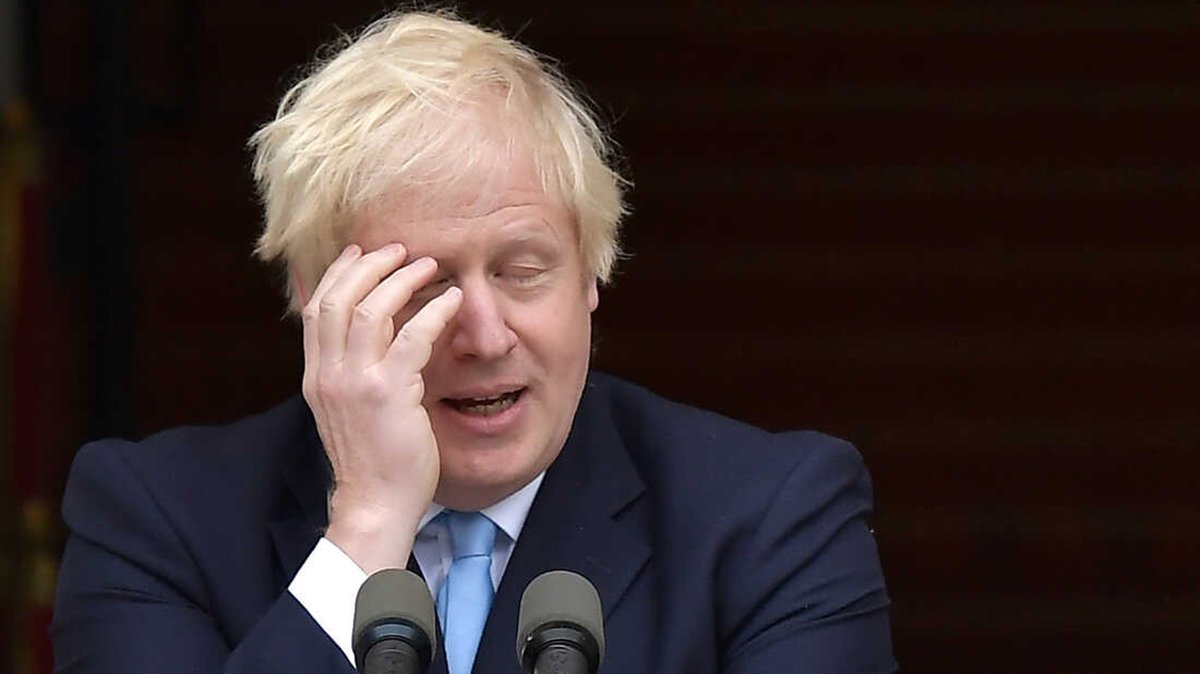
Cabinet ministers gathered in Boris Johnson’s official residence yesterday to tell him to quit as British leader after he insisted he would not stand down in the face of a mounting rebellion within his party.
With more than 30 government resignations and many lawmakers in his Conservative Party in open revolt, some senior ministers were in Downing Street to tell the prime minister he needed to go, BBC, Sky News and other outlets said. At least one was there to back him if he decided to fight on.
The 58-year-old leader’s grip on power has been slipping since Tuesday night, when Rishi Sunak resigned as finance minister and Sajid Javid quit as health secretary.

Both said they could no longer tolerate the culture of scandal that has dogged Johnson for months, including lockdown lawbreaking in Downing Street.
But at the parliamentary committee, and an earlier question and answer session with MPs in parliament, he defiantly vowed to get on with the job.
“I’m not going to give a running commentary on political events,” he told the committee when asked about the cabinet delegation.
“We’re going to get on with the government of the country.”
He added: “What we need is a stable government, loving each other as Conservatives, getting on with our priorities. That is what we need to do.”
Earlier, Javid urged other ministers to resign saying “the problem starts at the top, and I believe that is not going to change”.
“And that means that it is for those of us in that position — who have responsibility — to make that change.”
Cries of “bye, Boris” echoed around the chamber at the end of his speech. Most Tories were conspicuously silent when Johnson attacked the Labour opposition at prime minister’s questions. Some shook their heads.
Sunak and Javid quit just minutes after Johnson apologised for appointing a senior Conservative, who quit his post last week after he was accused of drunkenly groping two men.
Former education secretary Nadhim Zahawi was immediately handed the finance brief and acknowledged the uphill task ahead.
UK media said Nadhim Zahawi was one of the ministers who went to 10 Downing Street to ask the PM to resign.
Days of shifting explanations had followed the resignation of deputy chief whip Chris Pincher.
Downing Street at first denied Johnson knew of prior allegations against Pincher when appointing him in February. But by Tuesday, that defence had collapsed after a former top civil servant said Johnson, as foreign minister, was told in 2019 about another incident involving his ally.
At least 34 ministers and aides have quit the government since yesterday.
Tory MP Andrew Bridgen, one of Johnson’s most strident critics, said the Pincher affair had tipped many over the edge, and there were moves to get rid of Johnson by the end of this month.
Other senior cabinet ministers, including Foreign Secretary Liz Truss and Defence Secretary Ben Wallace, still publicly back Johnson.
But as the resignations piled up, many were wondering how long that may last.
A snap Savanta ComRes poll yesterday indicated that three in five Conservative voters say Johnson cannot re-gain the public’s trust, while 72 percent of all voters think he should resign.
Johnson only narrowly survived a no-confidence vote among Conservative MPs a month ago, which ordinarily would mean he could not be challenged again for another year.
But the influential “1922 Committee” of non-ministerial Tory MPs is reportedly seeking to change the rules.
If party bosses change the one-year rule on leadership challenges, rebel Tory MPs could try again to oust him through a vote of no confidence in parliament later this summer, or in the autumn. If Johnson loses the vote, he would have to resign or call an election.
Otherwise, he would have to resign himself – possibly in the face of cabinet pressure, like Margaret Thatcher – or after a fresh wave of ministerial resignations.
However, Reuters, citing three Conservative lawmakers, reported that a new confidence vote will not be brought by his lawmakers until at least next week, after the “1922 Committee” agreed to elect a new executive before considering allowing one.
The prime minister, who received a police fine for the so-called “Partygate” affair, faces a parliamentary probe into whether he lied to MPs about the revelations.
Pincher’s departure from the whips’ office — charged with enforcing party discipline and standards — marked yet another allegation of sexual misconduct by Tories in recent months, recalling the “sleaze” that dogged John Major’s government in the 1990s.
Conservative MP Neil Parish resigned in April after he was caught watching pornography on his mobile phone in the House of Commons.
That prompted a by-election in his previously safe seat, which the party went on to lose in a historic victory for the opposition Liberal Democrats.
Labour, the main opposition party, defeated the Conservatives in another by-election in northern England on the same day, prompted by the conviction of its Tory MP for sexual assault.