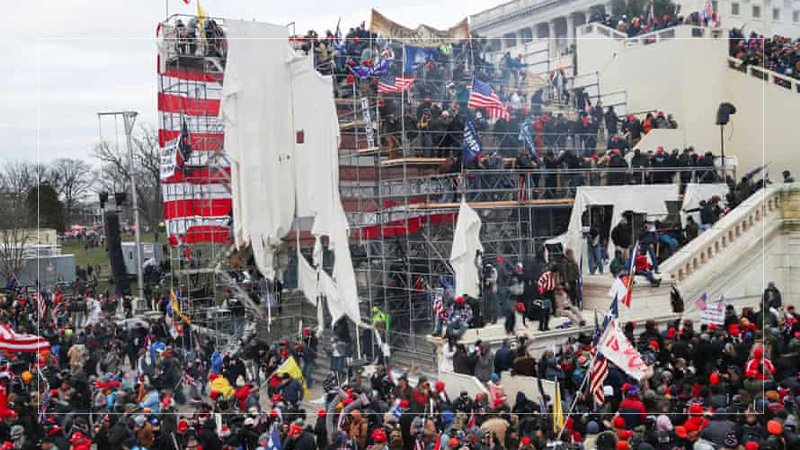
By a vote of 54-35, the Senate on Friday blocked a bipartisan proposal to create an independent inquiry into what led a violent mob of Trump supporters to storm the U.S. Capitol on Jan. 6, temporarily halting the certification of the 2020 presidential election.
Passage of the measure required 60 votes, but just six Republicans joined Democrats to vote in favor of the measure, which was passed in the House last week.
“Donald Trump’s big lie has now fully enveloped the Republican Party,” Senate Majority Leader Chuck Schumer said in a floor speech immediately following the vote. “Shame on the Republican Party for trying to sweep the horrors of that day under the rug because they’re afraid of Donald Trump.”

By a vote of 54-35, the Senate on Friday blocked a bipartisan proposal to create an independent inquiry into what led a violent mob of Trump supporters to storm the U.S. Capitol on Jan. 6, temporarily halting the certification of the 2020 presidential election.
Passage of the measure required 60 votes, but just six Republicans joined Democrats to vote in favor of the measure, which was passed in the House last week.
“Donald Trump’s big lie has now fully enveloped the Republican Party,” Senate Majority Leader Chuck Schumer said in a floor speech immediately following the vote. “Shame on the Republican Party for trying to sweep the horrors of that day under the rug because they’re afraid of Donald Trump.”
Supporters of President Donald Trump protest inside the U.S. Capitol
Trump supporters inside the U.S. Capitol on Jan. 6. (Roberto Schmidt/AFP via Getty Images)
After months of negotiations, Reps. Bennie Thompson, D-Miss., and John Katko, R-N.Y., introduced the bipartisan bill earlier this month to create an independent panel to investigate the violent attack on the Capitol and the inadequate law enforcement response.
Modeled after the 9/11 Commission, which studied the circumstances surrounding the 2001 terrorist attacks on the U.S., the proposed Jan. 6 commission was to be composed of 10 nongovernment appointees, five of whom would be selected by the leaders of each party. The committee would have been given bipartisan subpoena power.
Last week, the bill passed the Democratic-led House of Representatives 252-175, with 35 Republicans voting in favor of the creation of the commission, despite last-minute opposition by House Minority Leader Kevin McCarthy.
The legislation faced an uphill battle in the Senate, where Democrats have the slimmest possible majority. Ahead of Friday’s vote, just three GOP senators had said publicly that they planned to support the bill: Mitt Romney of Utah, Lisa Murkowski of Alaska and Susan Collins of Maine. In addition to those three, Republican Sens. Bill Cassidy of Louisiana, Ben Sasse of Nebraska and Rob Portman of Ohio also ended up breaking with party leadership and casting their votes in support of the commission.❐